The National Science Foundation’s Tribal Colleges and Universities Program continued its support of TCUs in 2026, making 18 awards that build institutional capacity and expand educational opportunities.
By Paul Boyer
A new interdisciplinary center for environmental research, an initiative to strengthen computer science instruction within K-12 schools, and development of a robotic wing that will help engineers create “bioinspired aerial–underwater vehicles” are among the projects funded through the National Science Foundation’s Tribal Colleges and Universities Program in 2026.
While federal support for STEM education and research continues to face an uncertain future, funding for the NSF’s Tribal Colleges and Universities Program (TCUP) remained stable in 2026, allowing the 25-year-old initiative to sustain its longstanding commitment to the nation’s tribal colleges and other eligible institutions.
A total of 18 awards to 12 institutions were made in 2026, based on analysis by the TCUP Hub. While the total amount awarded—a little over $14 million—is small when compared to the research budgets of many mainstream universities, it has had an outsized impact on the growth and development of STEM programs with tribal colleges.
Building Research Capacity
This can be clearly seen in the rapidly expanding research capacity of TCUs, which is the direct result of TCUP funding strands that support both individual faculty research projects and the development of interdisciplinary research centers. Awards made in 2026 support continued funding of one established research center—Chief Dull Knife College’s Environmental Research Center—and development of a new center at White Earth Tribal and Community College, located on the White Earth Reservation in northern Minnesota.
According to the award abstract, the $2.5 White Earth project will explore “critical food security and energy security challenges on the White Earth Reservation through interdisciplinary STEM research, education, entrepreneurship, and workforce development,” focusing on “applied research in sustainable agriculture, alternative energy, and integrated food and energy systems.”
At Northwest Indian College in Washington State, meanwhile, a new award made under TCUP’s Small Grants for Research (SGR) funding strand will support a project investigating how certain birds, such as puffins, are able to fly both in the air and under water. TCUP funding will allow development of a biomimetic robotic wing that will help engineers design “next-generation aerial–underwater vehicles,” according to the award abstract. These vehicles could be used for ocean monitoring and would be superior to current technologies, “which relies on expensive, ship-based surveys or fixed sensors with limited spatial coverage.”
Enriching STEM learning
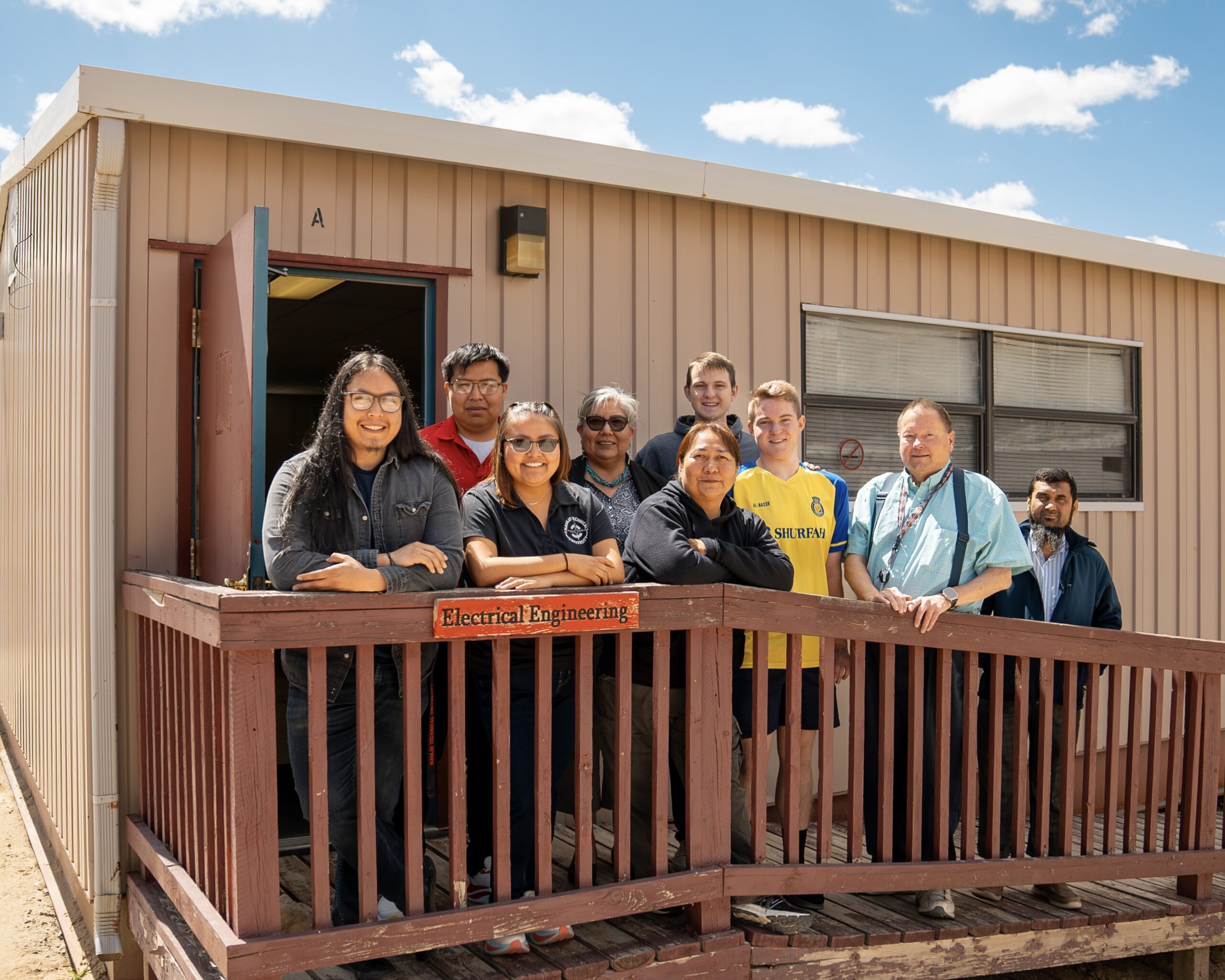
Developing new and strengthening existing academic programs is also a longstanding TCUP priority. Twenty-five years ago, most tribal colleges offered only a limited number of introductory-level undergraduate STEM courses. With NSF support, however, many TCUs now offer four-year and even graduate-level STEM degrees. In 2026 a new milestone was reached when Navajo Technical University announced plans to develop a PhD in electrical engineering. The TCUP-funded initiative will be the first doctoral-level engineering program within the tribal colleges, and only the second PhD to be offered by a TCU (see our related story here).
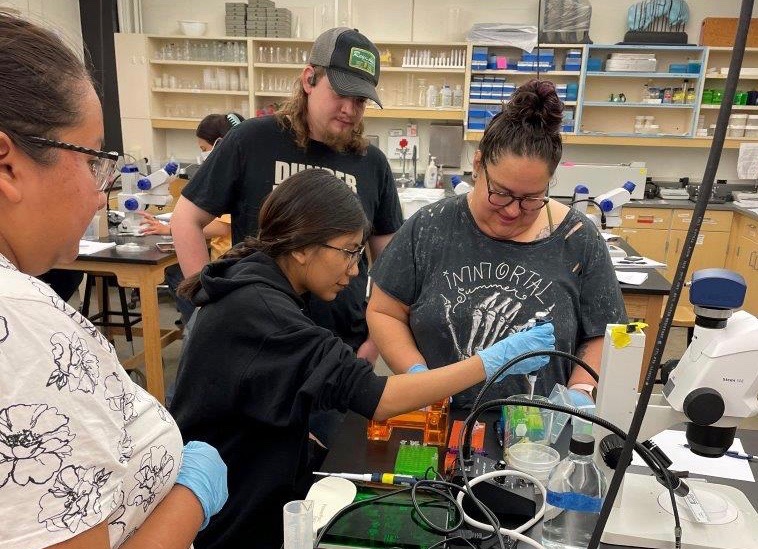
Several awards also support development of research opportunities for undergraduates. Encouraging students to learn science by doing science is widely believed to build interest in STEM and enrich student learning.
At Northwest Indian College, this is reflected in a new academic-year internship program in environmental science, supported by at $700,000 TCUP award. Student interns will participate in research experiences “that combine laboratory, field, and data analysis with mentorship from graduate students and research scientists,” according to the award abstract, that “will address real-world environmental challenges affecting the Salish Sea, including water quality, seafood safety, ecosystem monitoring, and natural resource management.”
AI, everywhere
Artificial intelligence was also a featured component of several successful proposals. At Navajo Technical University, a $344,000 award will support development of an artificial intelligence concentration within its existing undergraduate computer science program. Salish Kootenai College on the Flathead Reservation of western Montana, meanwhile, is incorporating AI into a project that aims to more fully integrate mathematics into its computer science coursework. The multi-pronged project will also work with local K-12 STEM educators to expand their understanding of AI, among other activities.
No less ambitious is Keweenaw Bay Ojibwa Community College’s plan to integrate AI and into an instructional capacity-building project that integrates additive manufacturing, AI biotechnology, sustainable design and applied microbiology into health sciences and STEM curricula.
Finally, several TCUs also received funding to strengthen cybersecurity through the TCUP program’s Cyberinfrastructure Health, Assistance, and Improvements (CHAI) funding strand. Additionally, funding was also awarded to several institutions and non-TCU organizations to underwrite the cost of an annual student research symposium and study the economic impact of TCUs.
A full list of 2026 NSF-TUP awards, generated by the TCUP Hub, is available here.
Paul Boyer is editor of the TCUP Hub.