The National Science Foundation’s Advanced Technological Education program supports the training of science and engineering technicians. Proposals from TCUP-eligible institutions are encouraged.
By Paul Boyer
While many tribal colleges now offer baccalaureate and graduate degrees, nearly all started as community colleges and, even now, the majority of TCU students enroll in certificate or associate degree programs, hoping to learn skills needed for employment.
Colleges looking for ways to strengthen this long-standing commitment to vocational and technical training should explore opportunities for funding through the National Science Foundation’s Advanced Technological Education (ATE) program, which supports the education of science and engineering technicians seeking work in high tech fields.
According to ATE Program Lead Olga Pierrakos, who presented at the Hub’s recently concluded proposal writing workshop, sub-baccalaureate careers represent over half of the nation’s STEM workforce and are, she said, “essential for our nation’s tech innovation leadership.”
The Advanced Technological Education program “supports curriculum development; professional development of college faculty and secondary school teachers; career pathway development for both students and incumbent workers; and other activities including applied research projects that advance the knowledge base related to technician education,” according to the program solicitation.
Workforce training programs eligible for ATE support include advanced manufacturing technologies, agricultural and bio- technologies, energy and environmental technologies, engineering technologies, information technologies, micro- and nano-technologies, security technologies, geospatial technologies, and autonomous technologies, among others, “as well as applied research on technician education that informs all supported areas.” AI and quantum information sciences—two areas specifically identified as priorities by the Trump administration—are also eligible.
In FY 2025, the ATE program was expected to distribute approximately $74 million in new and continuing awards. According to the NSF, the program expects to make 45-80 awards annually.
The ATE program is open to two-year and four-year institutions of higher education, non-profit and for profit entities, and state and local governments. The program solicitation specifically encourages proposals from minority serving institutions and tribal nations.
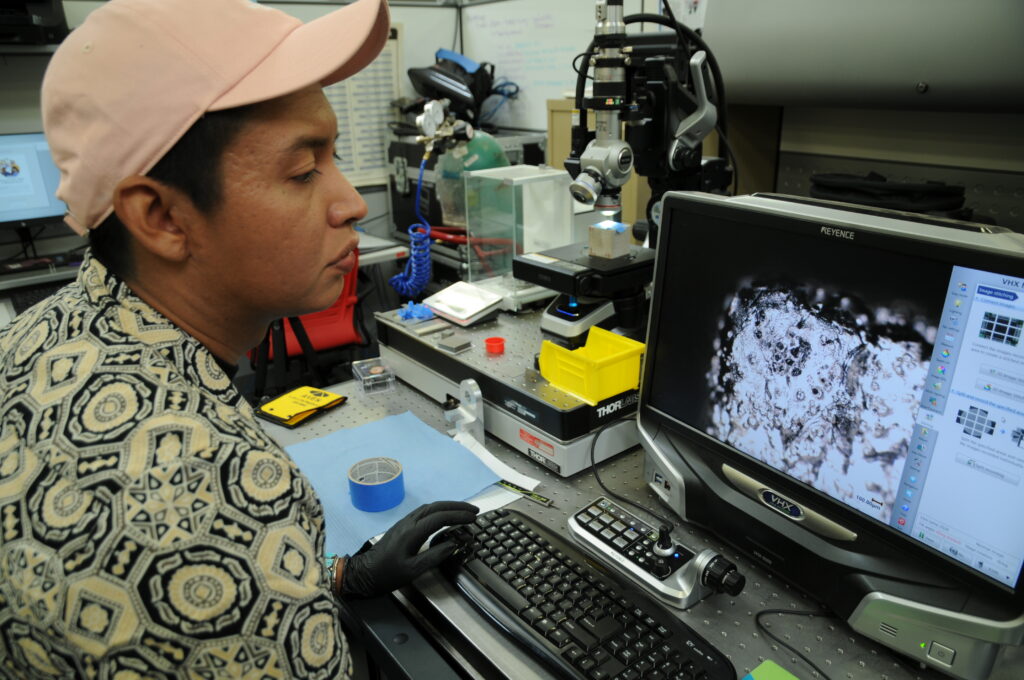
Several TCUs have received ATE awards in recent years. At Navajo Technical University, ATE supported development of professional certifications in metrology (the science of measurement). The 2015 grant allowed the college to purchase equipment and software, and offer training to NTU faculty, lab staff and student interns.
According to Scott Halliday, director of the university’s Center for Digital Technologies, the ATE project helped strengthen the university’s “technician to engineer to scientist progression.”
“Students learn how to use sophisticated equipment such as the 3D microscope and how to conduct analysis so they can perform their own research projects,” he said. “They learn how to operate the equipment, learn how manufacturing processes work and finally what is going on scientifically.”
Students who can confidently use equipment for analysis have an advantage when they look for work, he said. “So it is really paying off.”
At the College of the Muscogee Nation, meanwhile, ATE is currently providing the funding needed to create a geospatial technology-related curriculum. The award supports the recruitment Indigenous and underrepresented students and provides professional development and training for instructors and staff.
For More Information:
The 2026 full proposal submission deadline is October 1. For those interested in pursuing this underutilized funding opportunity:
The ATE Program solicitation can be found here: https://www.nsf.gov/funding/opportunities/ate-advanced-technological-education/nsf24-584/solicitation
ATE Central supports networking andprovides information about planned conferences and workshops: https://atecentral.net/home
A copy of ATE Program Lead Olga Pierrakos’s PowerPoint presentation is archived on the Hub’s Resource page, along with other presentations from at the Hub’s February 2026 proposal writing workshop: https://tcup-hub.org/?page_id=581
Paul Boyer is editor of the Hub website and a senior consultant for the Hub award.