A new study documenting the impact of NSF funding on the work of tribal colleges identified six factors that produce strong colleges and successful STEM programs.

By Gary Silverstein, Emerson Odango, and Stephen Shimshock
The Tribal Colleges and Universities Program (TCUP) Longitudinal Evaluative Study (TLEvS) was designed to describe the experiences of those affected by TCUP and document the impacts of TCUP on institutions and their surrounding communities. Funded by the National Science Foundation (NSF), the work represented an important opportunity to examine the institutional and community impacts of the program—with an emphasis on telling the story of how, and how well, the TCUP approach has worked. The overall purpose was to:
- Evaluate how TCUP is achieving its goals of increasing Native individuals’ participation in STEM careers, improving the quality of STEM programs at TCUP-eligible institutions, and facilitating the development of a robust STEM enterprise in TCUP institutions’ service areas; and
- Provide guidance to practitioners in similar circumstances (e.g., rural communities with low economic status that have limited access to higher education) who want to adapt similar approaches at their own institutions.
Begun in February 2025, TLEvS was terminated by the federal government for convenience in May 2025. At the time TLEvS was terminated, the study had begun work on several components—including reviewing literature on strategies for documenting TCUP-related institutional and community outcomes; assessing patterns of TCUP funding across all TCUP-eligible institutions; and developing protocols to guide the collection of data across site visits to 19 institutions that had participated in TCUP. A description of the first two of these study components is provided below.
Literature review. The literature review was designed to (1) summarize information about the practices and outcomes associated with TCUP and similar initiatives; (2) understand the underlying issues associated with measuring the institutional and community impacts of TCUP and similar place-based initiatives; and (3) develop a detailed inventory of indicators and corresponding data sources associated with TCUP outcomes at the institutional and community levels. The literature that we reviewed provided insights on how the institutional and community impacts associated with TCUP might be quantitatively and qualitatively measured (using a combination of existing data sources and new protocols). It also identified specific institutional and community indicators for which no current data exist, suggesting the need for new strategies to address these informational gaps.
Had the study continued, this review would have informed subsequent efforts to establish methods for assessing such TCUP-related institutional and community outcomes as increased academic rigor, increased student research opportunities, enhanced workforce development (including a focus on career and technical education), improved socioeconomic status, and increased tax base. Tracking these longitudinal trends would have enabled NSF and other interested parties to document institutional and community gains that are associated with TCUP funding.
Patterns of TCUP funding. The analysis of TCUP “career” pathways examined common chronological patterns of TCUP funding across all TCUP-eligible institutions. As shown in Exhibit 1, these empirically-derived career pathways illustrate how institutions progress from planning through maturity—with each of the five pathways having distinct characteristics, developmental stages, and critical success factors.
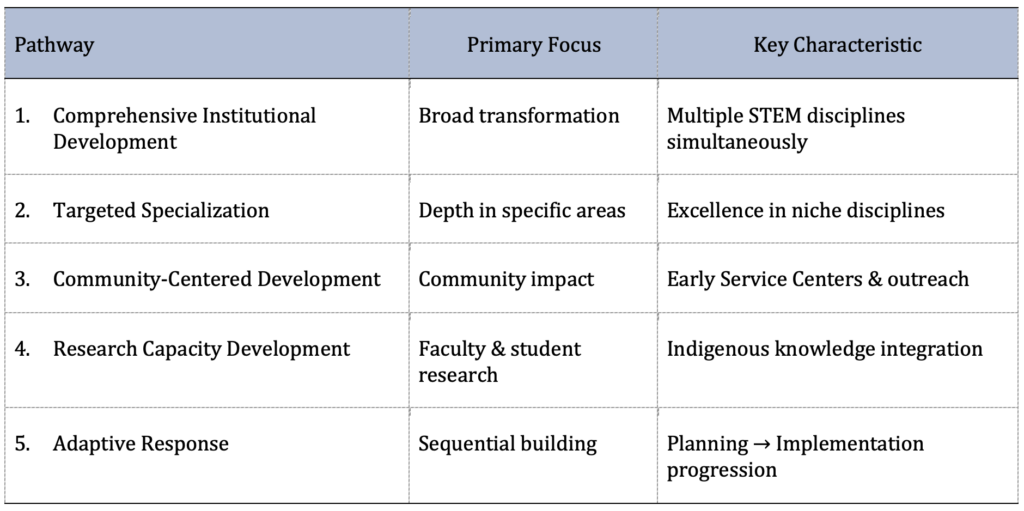
The analysis uncovered a series of universal factors of success that were common across all pathways—including:
- Sustained leadership commitment across multiple grant cycles and leadership transitions.
- “Grow your own” faculty development strategies supporting existing personnel through graduate education rather than relying primarily on external recruitment.
- Authentic cultural integration that positions Indigenous knowledge as foundational rather than supplementary.
- Strategic infrastructure investments aligned with programmatic priorities rather than opportunistic facilities expansion.
- Robust community partnerships and engagement mechanisms for interested parties.
- Realistic transformation timelines recognizing that sustainable change requires 10–15 years of sustained effort.
Our pathways analysis concluded that there are multiple routes to success in TCUP funding—with each pathway producing substantial institutional growth and student success. It also found that strategic clarity can help TCUP-eligible institutions understand their specific pathway (e.g., by helping institutions align grant sequences, infrastructure investments, and program priorities with institutional capacity and community needs). Going forward, findings from this analysis could be used to pair together institutions with similar TCUP award patterns, thereby enhancing opportunities for networking, peer learning, collaborative problem-solving, and sharing practices across institutions that share common goals and approaches.
How to reach us: The study team consisted of Westat, RAND, BCT Partners, Clarivate, ImagineED Partners, Education Northwest, and Mekinak Consulting. For more information about the study, please contact Gary Silverstein at garysilverstein@westat.com.
• • •
Gary Silverstein is an Associate Vice President for Education Studies at Westat. Emerson Odango serves as Principal Research Associate at Westat. Stephen Shimshock is Senior Evaluation and Analytics Manager at BCT Partners.